Sunday, April 8, 2012

Singapore Math in Kindergarten


Singapore math is not taught in kindergarten. The program begins in first grade. I want my students familiar with the process of model drawing so I begin teaching word problems that we solve as a class. I make sure that I pull in the key words from the eight steps of model drawing. These are: Read, who, what, draw, read, question mark, work computation, answer. As we work through the problem we go back to the model drawing chart to make sure we aren’t skipping any steps. Click on the picture below to download smartboard slides on the 8 Steps of Model Drawing, a word problem and step by step directions for how to teach the word problem using the model drawing strategy!  

We also do a lot of stories with pictures. Here are a few examples of craft we do with word problems. Once students finish with their pictures, they have to get into partners and tell their word problem to their partner.

Friday, April 6, 2012

Economics Carnival

Every year in we have a carnival in third grade to celebrate the end of our economics unit and put the principles we learned into action.  Kiddos get to experience opportunity cost when they have to choose what booth to spend their very last ticket on.  They experience scarcity when all the prizes at a booth are gone.  Each kiddo gets to be a consumer while they play at the carnival and a producer when it is their turn to run a booth.  They get to determine if their booth will be based on giving out goods or providing services.  They LOVE this unit and I have kiddos from past years coming back and telling me that they still remember the Econ Carnival.  How cool!

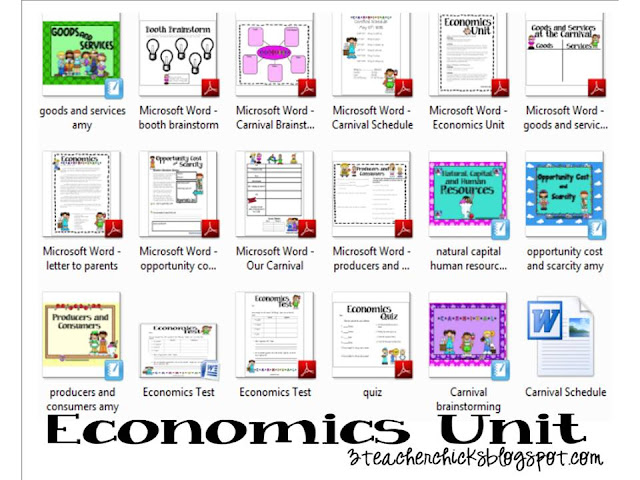
I am including some pictures from past carnivals to give you an idea of what it is like.  I have also included a freebie smartboard lesson about Human, Natural, and Capital Resources.  If you would like to download my 3-4 week unit with the lesson plans,smartboard activities, activity sheets, letter to parents, carnival schedule, quiz and test, visit my Teachers Pay Teachers Store by clicking the picture below.


Download this Economic Resources Smartboard lesson for FREE!

I hope you enjoy!
Amy

Thursday, April 5, 2012

Complete Sentences in Kindergarten!


Before I talk about writing, I wanted to show you my Easter bunny center that I made this week! I took a big coffee can and made it into a bunny. Then, I put sight words into plastic eggs. Students take out an egg, open it up, and read the sight word. If they can’t read it, they have to put it back. There are so many different games you could play with this. I’m going to put fake coins inside the eggs next week to change it up!


Now, on to writing! All year, I have told my kids that you need to write a sentence that includes “who” and “what”. Once my students were confident writers, I added the “where” part. The following activity is one way I teach my students to write a complete sentence.

I copied pictures of people and things(who) onto blue construction paper; verbs(what) onto yellow paper; and places onto green. Next, I hand each student a who, what and where card. He/she puts each card on the correct box and then wrote a sentence using the cards as a guide. When he/she are done with their sentence, they draw a picture in each box. 


After the kiddos write their sentence, I have them draw the who, what and where picture in the boxes. 


The first picture says: The woman is drawing in her bedroom on her carpet. The second picture says: The man cries at the circus. This time of year I have my students make stories out of these. So, they end up being story starters! Click on the picture to download the Who, What, Where page!


 How do you teach writing complete sentences? 

         -Shelley


Wednesday, April 4, 2012

Commas, Commas, Commas

Do your kiddos remember their commas?  Mine do!  (okay, most of the time)  I don't introduce commas by telling the kiddos the rules.  Instead, I have them come up with the rules themselves.  I give them a Comma Hunt paper and with a partner, they search through books to find three different ways that they see commas being used by real authors.  They try to find 3 examples to prove it is a rule.  Then they try to come up with a rule to present to the class. 

Once we discuss possible rules as a group, we create an anchor chart together.  I have the rules printed out and cut out already, so that I can easily glue them on.  We talk about the rules one at a time and the kiddos are THRILLED when they discover their rule is real!  I use examples the kiddos give me to record on the anchor chart.

For the next lesson, students search through books to find one example of each rule being used correctly.  They love this.  It gives them a real sense of ownership because they were involved in "making" these rules.  I tell them to make sure the authors used commas correctly, so the kiddo think they are looking for an author to make a mistake. =)

We leave the anchor chart up all year, and my little darlings refer to it often.  Enjoy!


I hope you can use this in your classroom!
Amy

Tuesday, April 3, 2012

Do you like to read?

So we are doing a book study on our second grade team called "Teaching Reading in Small Groups" by Jennifer Serravallo.  Our grade level has been discussing all of the "old school" techniques we have implemented in our classrooms to differentiate instruction for our struggling, on level, and advanced readers.  Luckily, we already have so many resources, our group pooled together some items that I wanted to share.  First of all, we went back to give our kiddos a reading inventory to see where they were at this point in the year with reading.  Of course, you have to have the "be honest about your answers" talk......which lead to me telling the kids that when I was their age, I very much disliked reading.  I had all kinds of negative experiences in elementary school.  Thank goodness they know that I enjoy math and science better, otherwise that would be a difficult conversation to have with parents.  (I can totally see myself in that situation haha).  I gave 2 inventories, one was for my on level and advanced readers, and the other was sufficient for my struggling readers.  I really got a good look at their affect for reading time, what they wanted out of reading, and what types of text they would like to read.  I attached the reading inventories below! Feel free to download them for free and utilize them to help you get a better picture of your students as readers!


I hope this helps you find out what your readers want to go, and helps to drive your reading instruction!
-Gretchen

Monday, April 2, 2012

Easter Reading and Writing Activities

I can't believe Easter is almost here! I had to scramble to  find all of my Easter activities before Good Friday! We started off by writing chick stories. By this time of year I expect my students to write more than one sentence but is hard to get the majority of kindergarten students to write a story on their own without some kind of structure. I  told my students to write a story but I gave them some guidelines for what to include. I asked them to include: their chick's name, to tell what he/she looks like and what he/she is doing.
This student wrote: My chick is a new born chick. Her name is
Avery. She is the cutest chick ever.


I had my students write about their chick on blank handwriting paper. Click on the picture below to download the cute chick writing if you would like to use it! Also, let me know how your smart kindergarteners are writing!

This week, we are also reading "The Tale of Peter Rabbit". I read the story and then put my students  into four groups. I assigned each group one section of the story map to complete. When everyone was finished, we met on the carpet and I wrote down the answers from each group onto the smartboard. This would also be a great writing activity during reader's workshop. I also included a page  that we are doing later in the week. Throughout the year, I have taught about speech bubbles and parenthesis in writing. I'm going to have my students write about what they think Peter Rabbit should tell his mom. I can't wait to read what my little creative kiddos will write! Click on the picture below to download both pages!


Sunday, April 1, 2012

Problem.....SOLVED!

Problem solving is always a tricky element to teach to students.  I have taught third grade, first grade, and now second grade.  Since our district has implemented Singapore Math, I have absolutely loved teaching the 8 Steps of Model Drawing.  This method has helped my students tremendously when it comes to analyzing and correctly answering problems in math.  The year our district started Singapore Math, I was teaching third grade.  I wasn't too overwhelmed about teaching problem solving, but the following year I moved to first grade.  I was totally in shock about how to help the students keep the 8 steps organized and readable.  I created this diagram to help them fill out as they moved through the 8 steps of problem solving. To my surprise, the kiddos totally got it and were successful as they solved the problems!  I have continued to use this diagram for the students even this year as I teach second grade.  I am fortunate to be able to see just how effective this strategy has been, since I have several students this year from my first grade class last year.


I uploaded my diagram- they are mini....I use these daily and the students get one per day to fill out and glue into their math workbook to solve problems.  You could glue them into a notebook, or I have even used them as exit slips and collected them as they leave for recess or lunch.  One of my co-workers, Kolleen, created a scoring rubric to go along with the model drawing process.  I fancied it up a bit and attached it for free as well.  Take a look at a few of the slides I added to the page as well.  If you want to purchase the whole unit, you can visit my Teachers Pay Teachers page by clicking on my button to the right!  I hope you have as much success as I have teaching problem solving!

addition


Have you ever used model drawing before?
-Gretchen

5-Star Blogger