Showing posts with label math games. Show all posts

Friday, April 25, 2014

It's About TIME!

Hey lovely followers and readers! How's it going? Well we made it to Friday! So this has seemed to be a crazy week. I sat at lunch with my wonderful teammates and told them how I felt like this has been the longest week we have had since Spring Break (3 weeks ago), but yet tomorrow is already Friday. I have had a hard time keeping my days straight this week. Maybe this wonderful test prep is getting to me. I wasn't going to post this week with all the craziness, but I think I have found an addiction to it. I would feel like I am letting you wonderful people down, so I just had to. Plus, I am feeling it is about TIME to get back into the swing of blogging weekly, if possible.

Speaking of time (as you can see, I try to use puns as much as possible), we just got done with our time unit and took the common assessment on Wednesday, so I thought I would share some things that I did with my kiddos.

I started out by telling time to the nearest minute, and immediately I found that my kiddos struggled with telling time if the hour hand was really close to the next hour but not quite there (ex: 11:55). They always wanted to say 12:55, since the hour hand was basically on the 12. This became a big frustration for me. Therefore, I had to take several days to review telling time to the nearest minute, and every time we were going to tell time, I would tell my kiddos that I would try to trick them. Also, in addition to telling me the time, I asked them how they got their answer (showing evidence). This really helped with the kiddos who struggled with telling time when the hour hand was so close to that next hour.

Once my kiddos were able to tell time to the exact minute, we moved on to elapse time. Instead of jumping straight into hours and minutes, I started with telling time to the next hour. This really helped them to see how once the big hand got to the 12, it was the next hour. Then I moved into doing elapse time with just hours. Following came elapse time with minutes, and we finished up with hours and minutes.

Since I have 2 math groups, I did this a little differently with my 2 groups. With my lower kiddos, I gave them clocks and put them in a clear zip-lock bag. This way they can write with on them with dry erase markers. I have a system that I model on the Smartboard. I first ask if the minutes have changed. If they have, then we see where the minute started and circle that number on our clocks (ones in our bags) and put an "S" (for start). Then we see what number our clocks ended on. Then we circle that number on our clocks (in the bag) and put an "E" (for end). By making the jumps with our dry-erase markers, we count the jumps by counting by 5's, since we are counting minutes. We record our answer for the minutes. Then, we check our hours and do the same thing. However, instead of circling the start and end numbers, I have them star them. This seems to be a great visual, especially for my lower kiddos. My teammates told me about using a time line to help as well. I didn't do it that way this year, as I am still in the works of learning that way. Just like any other subject, I struggle with teaching something I am not quite comfortable, so I stuck with my usual "comfortable" way. Next year, I plan on sitting down and becoming the student for a bit and learning about the time line, because I feel like it may be easier for my kiddos to understand.

With my higher group, I do things a little differently. I taught them how they can add/subtract time. I showed them how we can set up our math problem and trade. However, instead of trading a 100, we trade 60, since there are 60 minutes within an hour. This was very complex for them to understand at first, but it took no time for them to get it. I also threw in some challenges, as this way doesn't always work. I showed them how if the hour in the start time was bigger than the hour in the end time, you couldn't subtract the time to determine the elapse time. Instead, they had to use the clocks to determine it.

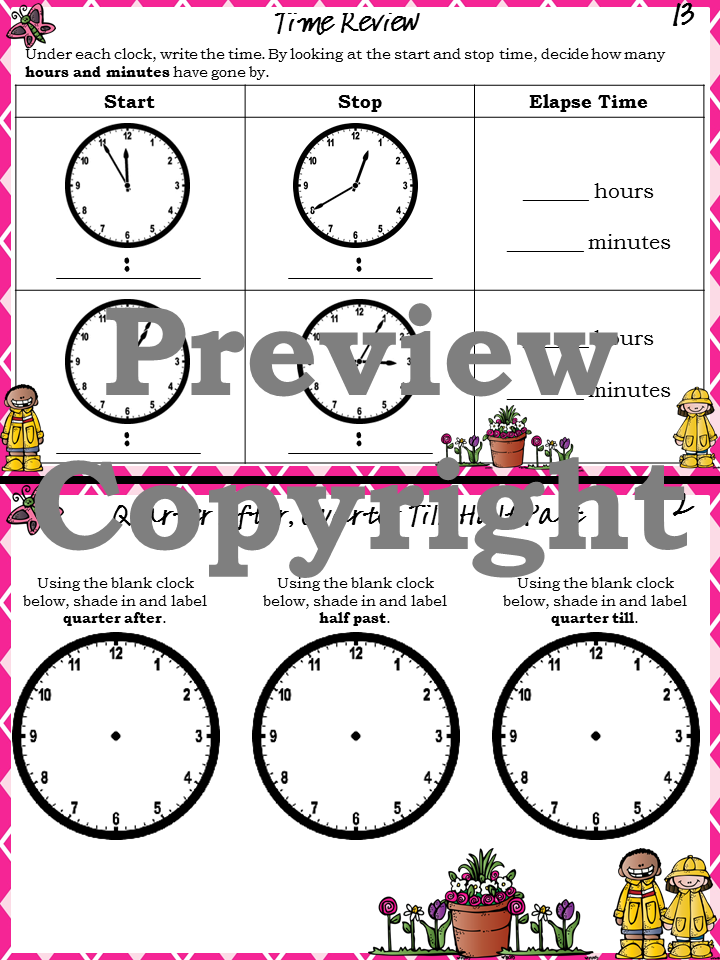
Similar to my Fraction Frenzy Interactive Book, I created a time booklet to go along with my time unit. It includes telling time to the nearest minute, elapse time (hours only, minutes only, and hours and minutes), telling time using quarter after/quarter till and half past, and comparing events with AM and PM.


In addition to the booklet, I used my games for a review of the concepts as well. This is my "It's Spring Time" game, which involves telling time to the nearest minute.


Because of time, I placed the cards around the room, instead of using it as a game, and had my kiddos complete the recording sheet. Then we reviewed the answers, which the answer key is included. However, I created this game to get the kiddos thinking about time and clocks, not just telling time. One partner picks a card and puts it on his/her forehead without looking at it. Then the other partner reads the clock and then checks their answer. Partner one (one with card on forehead) then starts asking Partner two yes or no questions to try to determine what time the clock says (ex: Is the hour hand on an even number? Is the minute hand past the 6?). They have up to 20 questions they can ask. I plan to use this as a center for a review during MAP Test Prep Friday centers.

Another great game is my Beat the Clock game. This involves elapse time.


Are you interested in these games/booklet? Click on the game/booklet title and it will take you to my TpT store where you can learn more about them. You can download a FREE time game by visiting an old post: Monday Made It & Time Freebie.

Just like any other math concept, I always try to find websites that are useful for my kiddos to play during independent work time. I have created shortcuts for these websites on my student computers on the desktop. I put all my various websites into different folders to help keep them organized. The kiddos love this as they are able to review all of the concepts we have covered so far. Here are a few websites that I have been using with my kiddos:


ABCya-Telling Time-If you need a review of how to create the time. This is a great website to use. The game goes through stages. The first stage is where the kiddos have to create the time to the nearest hour. Then it goes to the nearest 5 min. and so on.


What Time Is It?-This is a great website to use with your kiddos who are still struggling to tell time to the nearest hour and half hour. I used this with my lower kiddos who wanted to switch the hour and minute hands.


Time Games-This is a website that has different links to other time websites, which includes telling time to the nearest minute and elapse time.


KidsNumbers-Time Games-Again, a list of various time games that range from time to the nearest 5 minutes to the nearest minute.


MathNook-Online Time Math Games-This website is awesome as it has free games that line up with the Common Core State Standards.


As always, I appreciate you stopping by! I hope you are able to use some of the resources above! Have a FABULOUS Friday and enjoy your weekend! :)

What do you do to implement time in your classroom? What is your favorite resource that you use? Please leave a comment below, as we LOVE people who give us some new ideas!

 
Don't forget to follow us on BlogLovin'! :)


Thursday, March 27, 2014

Throwback Thursday & Limited Time Giveaway!!

THROWBACK THURSDAY=Addition & Subtraction Racing School post from July 2013
~~~~~~~~~~~~~~~~~~~~~~~~~~~~~~~~~~~~~~~~~~~~~~~~~~~~~~~~~~~~~~~~~~~~~~~~~~
Hey friends! So I was so intrigued by Amy's Multiplication Book Camp idea that I wanted to create something similar for the beginning of the year for addition and subtraction math facts. I wanted to something that the boys and girls both would be interested in. What better theme than racing!?!? So for those of you who saw Amy's post of Multiplication Book Camp back in May, this should be a little familiar to you (click on the link above to visit Amy's post for a refresher or introduction if you would like).

To start off, I will focus on addition first and give my kiddos a pretest to determine which facts they have already mastered and which facts they need more work on. Once each kiddo knows what facts they need to work on, they will be given flashcards (Pit Stops) and title cards for each fact number (Lap Cards) to practice every night for homework. These will be cut out, hole punched, and put onto a binder ring. That way they will be kept together.


The kiddos will complete Practice Laps every day (daily timed tests). They will keep track of their progress of the Practice Laps on the Lap Times sheet.


To go along with the Practice Laps and Pit Stops, there are games and activities that my kiddos will complete. Just like Amy, I too do Math Rotations in my classroom (click on the link to see Amy's post that explains what math rotations are). Therefore, when my kiddos are at the game rotation, they will be completing all of the games and activities that are included within this set (I will only choose one per day/week, depending on how long my kiddos need to complete each activity/game). These games/activities include the following (some have both addition and subtraction editions, some just have addition):
  • Winston Cup (Addition Chart Game)
  • Parking Lot (Addition & Subtraction Game)
  • Put the Pedal to the Metal (Build a Race Car Game)
Teacher example of the "Put the Pedal to the Metal" Game
  • Black Out (Addition & Subtraction BINGO)
  • Capture the Flags (Addition Strategy Game)
  • Red Light, Green Light (Addition Exercising Game)
  • Race Track (Addition & Subtraction Racing Game)

Once my kiddos graduate from Addition Racing School, they will move on to subtraction, which will follow the same format.


I got these cups that have black and white checkers on them from Party City. They were $1.00 for each one. I will use these to store my timed tests in.


I also found these pencils I will give to my kiddos after they graduate from the addition school. They too were from Party City. They come 12 in a pack.


I wanted to share a FREE activity for you to check out that goes along with this set. Download it by clicking on the picture below. If you like it, check out the Addition & Subtraction Racing School set in my TpT store by clicking here!


How do you help your kiddos learn their math facts?
~~~~~~~~~~~~~~~~~~~~~~~~~~~~~~~~~~~~~~~~~~~~~~~~~~~~~~~~~~~~~~~~~~~~~~~~~~~~

This could be yours! Get apart of my giveaway and you could choose this from my TpT store. Click here to enter into my GIVEAWAY!

HURRY BEFORE TIME RUNS OUT...you have until Saturday at 12:00 a.m.

Thanks so much to those who have already entered! I cannot wait to announce the winner on Saturday! Stay tuned!! Thanks for stopping by!!


Sunday, February 23, 2014

Graphing Activities & Ideas...Plus a FREEBIE!!

Hello lovely ladies and gentlemen! It has been a few weeks since I last posted. It's amazing how quickly time can slip out from under you, especially when you are teaching and trying to have a personal life as well. My husband and I have been going through a roller coaster with some medical things so my focus has been there more than anywhere else, which is my excuse for me being MIA for a few weeks now.

Speaking of time slipping away...all of these snow days have made it more difficult to get the necessities taught before the wonderful MAP test begins in late April. My team and I met on Wednesday this past week (we had a full release day) and started stressing over the little amount of time we have to cover so much "stuff".

On a side note...it's a wonderful thing when you work with a group of people who you can joke around with, be serious with at the necessary times, who you support through tough times, or who you can be crabby with and STILL get along and like each other. The best part...we don't take it personally, hold grudges, or get mad at each other. I am VERY fortunate to work with a fabulous team as just described.

Anyways, we talked about the remaining part of our academic calendar and planned out how many weeks we are going to hit on the major concepts that we need to cover before the wonderful MAP test begins. Graphing is one of the concepts we are getting ready to cover, after we finish up with our measurement unit later this week.

As we collaborated, we started talking about different ways we could incorporate graphs within the classroom. We find that students still struggle with answering questions from graphs that are given, especially if they are pictographs where they have to determine the value of each object. After much collaboration, we decided that we will incorporate a graphing activity in the centers that we do during RTI (Response to Intervention/Instruction) time.
   
Groovy Graphs is a FREE activity where your students can create their own graphs and can be used universally. In addition there are graphing questions that your students can answer based on the graphs that they create.

Students create either a bar or pictograph by developing a theme and variables that are associated with that theme. They roll 2 dice to determine how many votes are given for each variable and then graph the total amount rolled. After all variables have been graphed, the students then answer the questions (included on a separate page) under their graphs. They can work individually or with a partner to create their graphs. Click here to download Groovy Graphs for FREE!!!


In addition to the Groovy Graphs activity, I also have a graphing game within my Major League Math centers that is similar to Groovy Graphs but is within a baseball theme. (Check out the other concepts that are included within the Major League Math centers by clicking on the link above.)


Some other graphing ideas that I wanted to share with you include the following:
  • Math-Aids-A coworker of mine told me about this awesome website where you can quickly create worksheets for various math concepts. I use this website especially for my lower students. Click on the link to look at the various graphing options this website has to provide.
  • Math Data Game For Kids-This is a great technology resource, especially for your lower level learners or for introducing graphs. Students get to determine the amount of tallies made and then create a bar graph that shows the amount of tallies. Upon completion of the bar graph, your students then get to create a pictograph (which even includes the key where each one is worth more than 1). Great resource for a center or to put on your student computer(s) for your students to work on.
  • You could also have your students determine a theme that they would like to survey a group of people on. Have them survey the people (students and teachers within your school or can survey people at home) and then create a graph to determine their findings.
  • Hand out candy to your students and they have to graph the candy (they determine how they are going to graph the candy). Then have them share with the class the strategy they used to graph their candy.
  • Basic Skill Practice Games-a plethora of math graphing ideas and links to click on.
Thanks for stopping by today! Don't forget to follow us on


How do you incorporate graphs within your classroom? What other suggestions or resources do you have for graphing?

Happy Sunday!


Monday, January 27, 2014

MOOLAH

Hello to all you wonderful teachers and bloggers! Just like Shelley, things have been crazy for me as well, so I apologize for being MIA for a while.

Since I last posted (terrible to say but I cannot even remember when...all I know is it was at the beginning of the school year), a lot has happened. I graduated with my Masters in Educational Technology in December from the University of Missouri (MIZ-ZOU). That was the best feeling in the world. It still feels surreal that it's all over with, as it felt like I just started. Call me crazy...but I have been thinking about starting up my doctorate degree. I haven't applied or anything but have been seriously thinking about it.

Callie sitting with Grandpa a few weeks ago

Along with my masters, I helped welcome my new niece, Calliope "Callie" Ann, into this world in September. I have been obsessed ever since I met her. I will admit..it was an interesting experience as Philip and I don't have any children yet, but it was all so worth it. Here are some pictures of my adorable niece.

Callie a few weeks after she was born
 
 
Ok...enough with the updates with me. Now onto talking about money! Who doesn't love money!?

We just started teaching money in 3rd grade at my school. We are a little behind with our schedule due to various snow days (we are up to 7 now), but that's what I have learned with teaching...you rarely follow a schedule exactly. Anyways, I wanted to share a few ideas that I am using in my classroom.

On the first day I introduced money, I split up my kiddos into 6 groups. I gave each group a cup of coins and a piece of paper. I sent the groups off by telling them that they had 5 minutes to write down as many words to describe the money as possible. I told them I wanted them to think that I didn't know anything about the money. Then we came back to the floor and discussed what they came up with. I created an anchor chart with some of their answers. Their answers varied from what the coins looked like, to its use, to the value of the coins. I thought this was a great hands on activity where all learning abilities were engaged.

For the remaining part of the money unit, I am going to focus on adding money and making change. Since I have two math groups I meet with daily, I will teach making change to $5 for my lower kiddos, and for my higher kiddos, $20 and higher.

I plan to use the Math Academy-Dining Out resources. I printed out some of the menus and corresponding questions. Every student will get a menu. However, my higher kiddos will be the only ones to receive the questions. You can also get some local restaurant menus or store ads to use with your kiddos.

While I am meeting with my lower group (I meet with them first), my higher group will be working on answering the questions with corresponding menus. If they finish, they get to work on a challenge packet that comes from the Singapore Math Program and/or play my Money War game. I use the challenge packet as homework too.


With my lower group, I plan on asking them questions from the menus and having them add the items up and make change.

For example, I bought a hot dog and a soda. How much did I spend? Then, I used $5 to pay for it. How much change will I get back? I will have them create the change using two different combinations. They will work with a partner or individually to answer these questions. I will work with my struggling students as needed.

After meeting with my lower kiddos, they will work on the corresponding workbook pages, which comes from the Singapore Math Program. This will happen for several days.

Another idea I may use is having my students create a menu. When they have completed the menu, they will get with a partner and practice buying items from the menu and making change. This may be something they do when they have free time.

The following are also websites I am going to try to use with my kiddos as well:

Enough from me...what about you? How do you teach money and making change?

The first 2 people to reply will receive my Money War game for free. Please make sure to include an email address with your response.

Also, don't forget to follow us on Bloglovin to stay in the loop! :)


Saturday, September 7, 2013

Place Value is SOO Valuable!

Hello darlings!  I think everybody has a place value unit that they start the year off with.  We gauge to see what our kiddos remember from last year, and then we add on.  Common Core has upped the ante and really requires students to understand place value to be able to use mental math strategies to add, subtract, multiply, and divide larger numbers.   Here is a peek at what we do in third grade....

Students have place value mats and place value discs. (from Singapore Math)  We use these to visually represent numbers so we can complete number patterns and decide greater than and less than.


Here are a few games we play.  The first game is a FREEBIE!

This is a PART of our SCOOT games, but you can see the kinds of questions we are working on.  Click the pic to get the SCOOT game.


This is a Quick Check just to see how they are comprehending.


The next few pics are from two of my smartboard lessons.  I chose a few slides to show you and give you ideas of the types of questions you can ask your kiddos.


This project is my favorite part of our unit!  We are reading the book POPPY by Avi for Interactive Read Aloud, so I created a themed Place Value review using the POPPY characters.  The kiddos loved it!  It does have some challenging questions that require kiddos to EXPLAIN their thinking.  They have to PROVE their answer which is a must do in the Common Core!


Want these awesome resources?  Click the pic below to get the entire unit of supplemental materials. 


Have a fantastic weekend!  And make sure to follow us on Bloglovin!
Want this unit for free?  Leave a comment with your email and I will randomly choose a winner on SUNDAY!!!


5-Star Blogger